Who Owns Ford? Shareholders Hold the Stock, the Family Holds the Votes
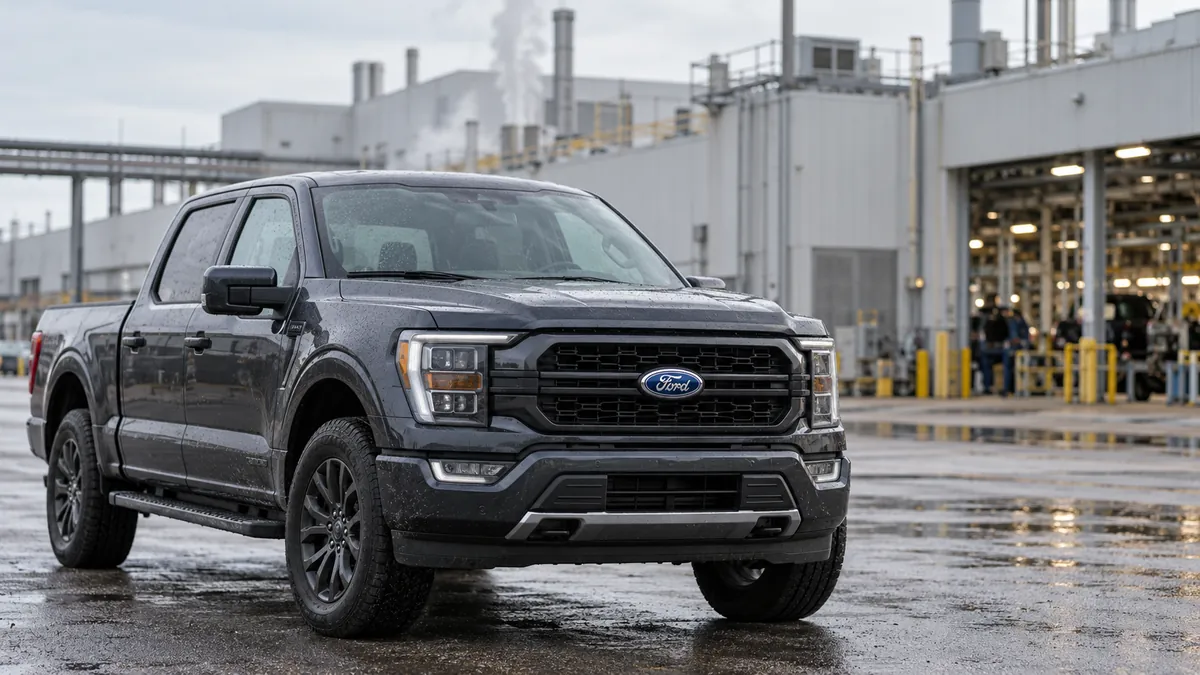
Ford Motor Company is owned by its public shareholders, and the biggest of them is Vanguard, followed by State Street and BlackRock. Control sits elsewhere: the Ford family’s Class B shares make up less than 2% of Ford’s stock but carry 40% of the votes, according to Ford’s 2026 proxy statement.
So the question of who owns Ford has two honest answers. The money belongs mostly to index funds and millions of ordinary investors. The steering wheel, for most practical purposes, still belongs to Henry Ford’s descendants.
Key takeaways
- Vanguard is Ford’s largest shareholder, with 457.7 million shares, or 11.68% of the common stock.
- The family’s 70.85 million Class B shares are 1.8% of all shares but 40% of the vote. Each carried 37.075 votes at the 2026 meeting.
- A one-share-one-vote proposal got 43% of votes cast in May 2026. By my estimate, about 9 in 10 non-family votes backed it, and it still lost.
- Ford owns two vehicle brands today, Ford and Lincoln. Jaguar, Land Rover, Volvo, Aston Martin and its Mazda stake were all sold by 2015.
Who is the biggest shareholder of Ford?
By shares, it’s Vanguard. By votes, it’s the Ford family voting trust, which holds 99.9% of the Class B stock.
Ford’s 2026 proxy statement, filed with the SEC on March 27, 2026, lists only three outside investors above 5%, and all three are index-fund giants.
| Holder | Shares | % of common stock | Approx. % of all votes |
|---|---|---|---|
| The Vanguard Group | 457.7 million | 11.68% | 7.0% |
| State Street | 329.4 million | 8.41% | 5.0% |
| BlackRock | 327.6 million | 8.36% | 5.0% |
| Ford family voting trust | 70.8 million Class B | Separate class | 40% |
Common-stock positions as of December 31, 2025, from the Schedule 13G filings cited in Ford’s 2026 proxy. Vote shares are my calculation using the March 16, 2026 record date: 3.94 billion common votes plus about 2.63 billion Class B votes.
These managers hold Ford mostly through index funds for millions of savers. They don’t run the company. Part of State Street’s figure also reflects its role as trustee of Ford’s own employee savings plan trust, which holds 3.5% of the common stock.
Online, Vanguard’s stake shows up anywhere from about 8% to 12%. The proxy uses Vanguard’s own group-wide 13G/A filing, while trackers often use other dates or fund-level data. BlackRock, for its part, is a listed company with its own ownership story (see who owns BlackRock).
How does the Ford family control Ford with under 2% of the shares?
Ford created two classes of stock when it went public in 1956. The Ford Foundation sold part of its non-voting stake to the public, and the family kept a special voting class. That’s the Class B stock, and its 40% share of the vote dates back to that listing.
A formula in Ford’s certificate of incorporation resets the votes per Class B share each year so the class keeps 40% of the total. For the May 2026 meeting, each Class B share carried 37.075 votes, up from 36.75 in 2025. Each common share got one.
Four rules make that 40% stick:
- Only the family can hold it. Owners are limited to Ford family members, their descendants and certain family trusts or companies. Selling means converting to common stock first, which cancels the extra votes.
- It votes as one block. The voting trust holding 99.9% of Class B is run by Edsel B. Ford II, William Clay Ford Jr., Benson Ford Jr. and Alfred B. Ford, and it votes as a plurality of its shares directs.
- It has its own veto. A majority of Class B, voting as a class, must approve a merger, a sale of substantially all assets, a dissolution or changes to the share structure.
- The 40% has a floor. The class keeps 40% as long as at least 60,749,880 Class B shares exist. Below that it drops to 30%, and below 33,749,932 each share gets one vote. With 70,852,076 outstanding, the family could convert about 10.1 million shares, roughly 14% of the class, before losing anything.
Is 40% really control?
Some sites say the family has majority voting power. It doesn’t. 40% isn’t a majority.
In practice it behaves like one, because plenty of common shareholders never vote. On the one-share-one-vote item at the 2026 meeting, the family’s roughly 2.63 billion Class B votes made up about 52% of all votes cast for, against or abstaining. Add the class veto, and nobody can merge with Ford or rewrite its share structure without the family’s sign-off.
The economics are lopsided too. At $13.80, the price on the cover of Ford’s 2025 Form 10-K (February 6, 2026), the Class B stock was worth about $978 million, against $54.1 billion for the common stock. Roughly $1 billion of stock carries 40% of the say. Class B gets the same dividend per share as common, so the family isn’t paid extra for its control.
Does the Ford family still own Ford?
The family controls Ford but owns only about 1.8% of its shares. Its power comes from votes and board seats.
Three of Ford’s 15 directors are family: Executive Chair William Clay Ford Jr. (Bill Ford), a director since 1988; his daughter Alexandra Ford English; and Henry Ford III, his first cousin once removed. Day-to-day management belongs to CEO Jim Farley, who took over in October 2020 and owns about 0.16% of the common stock, including exercisable options.
Bill Ford is the most powerful individual holder. The 2026 proxy lists him as beneficial owner of 27.55% of the Class B stock. My math puts that at roughly 11% of Ford’s total votes, more than Vanguard’s 7%, although those shares sit in the family voting trust rather than being voted by him alone.
What happened when shareholders voted on one share, one vote in 2026?
On May 14, 2026, shareholders again voted on a proposal asking the board to move toward one vote per share. The board opposed it, and it failed with 2,170,748,325 votes for and 2,848,002,181 against, according to Ford’s 8-K filed May 19, 2026. That’s 43% support among votes cast for or against.
That undersells the frustration. Ford doesn’t report votes by share class (a proposal asking it to was also rejected), but the math narrows it down. If the family trust cast all its votes against, as the board recommended, only about 220 million outside votes opposed the change while 2.17 billion supported it. That’s roughly 9 in 10 non-family votes for equal voting rights.
That’s my estimate, not a disclosed figure. It also shows why the vote changes nothing. Even if every outside vote cast had been a “for,” the total of about 2.39 billion would still fall short of the family’s 2.63 billion.
Is Ford still an American-owned company?
Yes. Ford is incorporated in Delaware, headquartered at One American Road in Dearborn, Michigan, and listed on the New York Stock Exchange under the ticker F. Its three largest outside shareholders are US asset managers, and the family voting trust is administered from Detroit. Ford doesn’t publish a breakdown of shareholders by nationality, so any “foreign ownership” percentage you see is a guess.
It isn’t owned by China either. Ford’s Chinese business runs through joint ventures such as Changan Ford, plus a minority stake in Jiangling Motors. Those are Ford’s investments in China, not Chinese stakes in Ford.
For UK readers, Ford of Britain is the British operating arm of the same Dearborn parent, with no separate local owner. In India, Ford stopped building cars in 2021 and sold its Sanand plant to Tata Motors in 2023. It’s coming back, but only to make engines: in October 2025 Ford signed an agreement with Tamil Nadu to invest ₹3,250 crore in its Chennai plant to make engines for export from 2029. About 12,000 people already work for Ford in the state in global business operations.
Are Ford and GM the same company?
No. Ford and General Motors are separate public companies and direct rivals. GM owns Chevrolet, GMC, Buick and Cadillac and has no ownership link to Ford.
Their paths split in 2009, when GM went through a government-backed bankruptcy that wiped out its old shareholders and Ford avoided a bailout. Had Ford gone the same way, the family’s Class B shares would almost certainly have gone too.
What brands does Ford own?
Ford sells vehicles under two brands, Ford and Lincoln, and owns its lending arm, Ford Motor Credit, outright. Nearly everything it collected from the late 1980s on has since been sold or shut down.
| Brand or business | Status | Year |
|---|---|---|
| Ford | Owned | Since 1903 |
| Lincoln | Owned | Bought 1922 |
| Ford Motor Credit | Wholly owned finance arm | Current |
| Aston Martin | Sold to an investor consortium | 2007 |
| Jaguar and Land Rover | Sold to Tata Motors | 2008 |
| Volvo Cars | Sold to Geely | 2010 |
| Mercury | Discontinued | 2011 |
| Mazda stake | Fully sold | 2015 |
The Mazda exit took the longest. Ford held about a third of the Japanese carmaker at its peak and sold down in stages until nothing was left; here’s who owns Mazda today.
What Ford’s setup means if you buy the stock
My take: buying F gets you a slice of the profits and dividends on the same terms as the family, plus a vote that can’t outweigh theirs. That’s the deal, disclosed since 1956. If you want a real say in who runs the company, Ford is the wrong stock. If you’re betting on trucks, Ford Pro and Ford Credit, a family that has stuck around for over 120 years isn’t a drawback in itself.
Ford isn’t the only carmaker built this way. Ferrari’s controlling shareholder also gets extra votes through a loyalty-share system (see who owns Ferrari). For founders, the lesson is simple: dual-class stock lets you raise public money and keep control, but you’ll defend it at annual meetings for decades. Ford has been doing that since the Eisenhower administration.
More questions about who owns Ford
Does the Ford Foundation own Ford?
No. Henry and Edsel Ford created the Ford Foundation in 1936, and it once held most of Ford’s non-voting shares. It sold its entire Ford stake between 1955 and 1974. Today it’s a separate New York-based charity with no ownership of, or role in, Ford Motor Company.
Did the US government ever own part of Ford?
No. During the 2008 to 2009 crisis, GM and Chrysler went through government-backed restructurings that left the US Treasury holding stakes in both. Ford had borrowed heavily in 2006, pledging most of its major assets, and used that cash to get through without a bailout or government shareholding.
Who founded Ford Motor Company?
Henry Ford founded it with 11 other investors, including coal dealer Alexander Malcomson and the Dodge brothers, and incorporated it on June 16, 1903. Ford later bought out the outside shareholders, so the company stayed wholly family-owned until the 1956 stock market listing created today’s two-class structure.

Discussion