How Does GoodRx Make Money? PBM Fees, Drugmakers and Subscriptions
How does GoodRx make money? GoodRx earns fees on coupon prescription fills, plus drugmaker payments and subscriptions.
GoodRx makes most of its money from a fee paid each time someone fills a prescription with a GoodRx coupon: the pharmacy benefit manager (PBM) behind the discount charges the pharmacy a fee and passes part of it to GoodRx for sending the customer. In Q2 2026, those prescription transaction fees brought in $106.4 million of GoodRx’s $200.4 million revenue, with drugmaker deals and subscriptions making up most of the rest, according to the company’s August 5, 2026 results.
Users pay nothing for the coupons. The catch is in who does pay, and why some pharmacies resent it.
Key takeaways
How GoodRx makes money: four revenue streams
GoodRx reports four lines. Here’s how the mix looked across full-year 2025 and the most recent reported quarter.
GoodRx revenue mix. FY2025 figures: GoodRx’s 2025 Form 10-K and February 25, 2026 results. Q2 2026 figures: GoodRx’s Form 10-Q filed August 5, 2026.
- Prescription transactions ($544.0M in 2025; $106.4M in Q2 2026, down 26%). PBM and pharmacy fees on coupon fills.
- Pharma Direct ($151.4M in 2025; $61.6M in Q2 2026, up 76%). Drugmakers pay to promote their medicines, copay cards and self-pay programs to GoodRx users.
- Subscriptions ($83.8M in 2025; $28.5M in Q2 2026, up 39%). Paid plans such as GoodRx Gold and the newer Companion plan, with 764,000 plans at June 30, 2026.
- Other ($17.7M in 2025; $3.9M in Q2 2026). Telehealth and smaller services.
The shift is the story. In barely a year, GoodRx went from a company where two of every three dollars came from coupon fees to one where nearly half comes from drugmakers and subscribers. GoodRx blamed the transactions drop on pharmacy closures, lower volume in one integrated savings program and a deliberate move toward subscriptions.
Is GoodRx profitable?
Yes, though thinly on the bottom line. GoodRx reported net income of $30.4 million on $796.9 million of revenue in 2025, a 3.8% net margin, while adjusted EBITDA was $270.5 million, about 34% of revenue (February 25, 2026 release).
The gap between those two numbers comes from items adjusted EBITDA leaves out, such as stock-based compensation, depreciation and interest on debt. In Q2 2026, net income was $8.5 million, down from $12.8 million a year earlier, even as the company raised its full-year guidance.
How does a GoodRx coupon actually make money?
GoodRx’s own site says it doesn’t negotiate or set medication prices. Those prices come from contracts between PBMs and pharmacies. GoodRx’s role is to put the cheapest of those contracted prices in front of you.
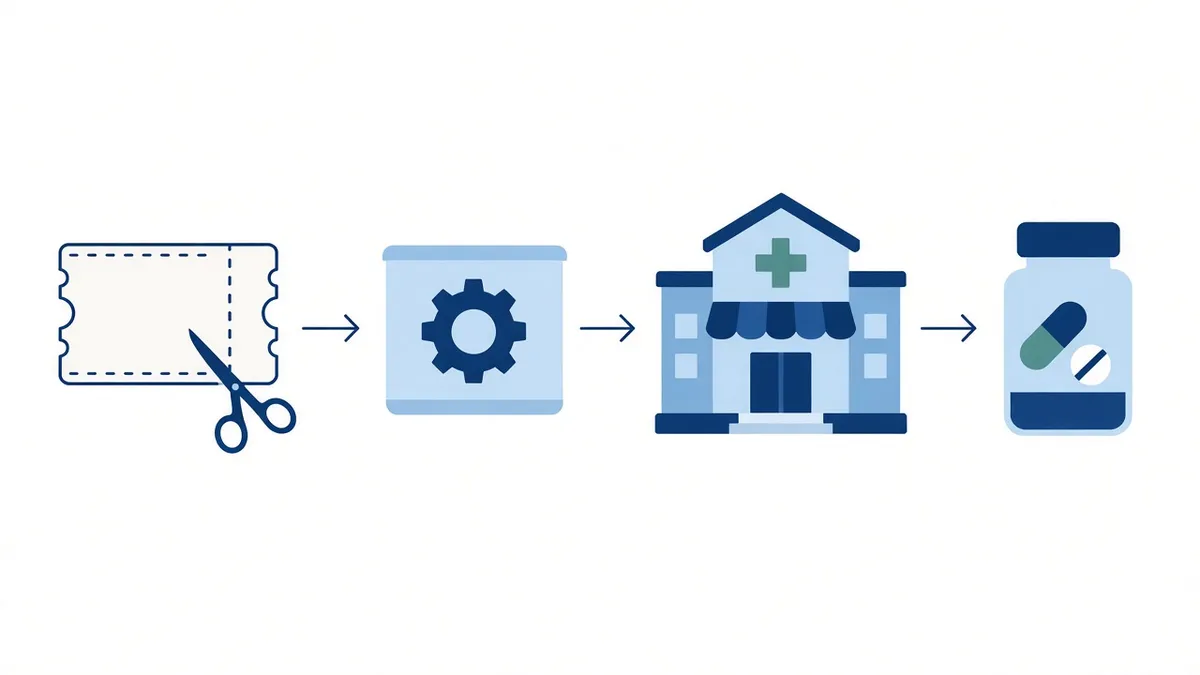
| Step | What happens | Who gets paid |
|---|---|---|
| 1. You show the coupon | The pharmacist runs it like an insurance claim through the PBM named on the coupon | Nobody yet |
| 2. The PBM prices the fill | You pay the PBM’s network rate, usually below the pharmacy’s cash price | Pharmacy collects your payment |
| 3. The PBM charges a fee | The pharmacy pays the PBM an administrative fee for the claim | PBM |
| 4. GoodRx gets its cut | The PBM shares part of that fee, or pays a fixed amount per fill | GoodRx |
GoodRx still describes this split in its 2025 10-K: most PBM contracts pay a percentage of the fees the PBM charges pharmacies, and a minority pay a fixed fee per transaction.
It’s a referral business. Honey earns affiliate commissions on shopping coupons and Upside takes a profit share from stores, and Fetch Rewards gets paid by brands for the purchases it drives; GoodRx does the same thing with prescriptions, except the payment flows through a PBM.
How can GoodRx sell drugs so cheaply?
It doesn’t sell drugs at all. The low price comes from two gaps GoodRx exposes.
Inflated cash prices. Pharmacies post a “usual and customary” cash price that’s often far above what insurers and PBMs actually reimburse. Uninsured customers who walk in without a coupon pay that list price.
Multiple PBM networks. GoodRx works with several PBMs, so it can compare their contracted rates at each pharmacy and show you the lowest. That’s how it claims savings of up to 80% and an average of $150 per claim against cash prices in 2022, on its “How GoodRx works” page.
How does GoodRx get lower prices on brand-name drugs?
Increasingly through drugmakers. Pharma Direct deals let manufacturers offer self-pay prices directly to GoodRx users. In April 2026, for example, GoodRx announced access to Wegovy HD at a $399 per month self-pay price. The drugmaker pays GoodRx to reach those patients.
Do pharmacies make money with GoodRx?
Sometimes. A pharmacy still collects the coupon price and gains a customer who might have gone elsewhere. But it’s reimbursed at the PBM’s discounted rate and then pays the PBM’s fee on top, so on some drugs the margin disappears.
An independent pharmacist told CNBC in 2020 that pharmacies can end up losing money on discount cards depending on the drug. GoodRx’s co-founder argued then that the service is a net positive for pharmacies overall.
Why do pharmacies not like GoodRx?
Three complaints come up most:
- Fees on customers they already had. A regular cash customer who starts using a coupon now costs the pharmacy a fee.
- Low reimbursement. The coupon price is set by PBM contracts the pharmacy has little power to negotiate.
- Alleged collusion. Independent pharmacies have filed antitrust suits since late 2024 accusing GoodRx and major PBMs of conspiring to push down generic drug reimbursements, Reuters reported in November 2024. The suits were centralized in a multidistrict litigation in 2025 and remained unresolved as of this draft; the allegations have not been proven.
What’s the catch in using GoodRx?
For most people, the coupon itself has no hidden cost. The trade-offs are elsewhere:
- It isn’t insurance. GoodRx says you can’t combine a coupon with your insurance on the same fill, so you choose whichever price is lower.
- Prices move. GoodRx recommends pulling a fresh coupon for every refill, since the best price can change.
- Your data has value. In February 2023, the FTC fined GoodRx $1.5 million for sharing users’ health information with advertising platforms including Facebook and Google without proper consent.
- You’re the audience for drug marketing. Pharma Direct revenue comes from manufacturers paying to reach you.
If your plan has a high deductible, it’s worth checking how the cash purchase interacts with your coverage. How insurance companies make money explains why health plans and their PBMs price drugs the way they do.
Our read: GoodRx built a profitable toll booth on a confusing drug pricing system, and it’s now trying to get paid by the drugmakers and subscribers instead of relying on that booth. With monthly active consumers down to 5.0 million and 2026 revenue guidance of $790 million to $805 million (GoodRx’s August 5, 2026 earnings release), the next year will show whether Pharma Direct grows fast enough to cover the shrinking coupon business.


Discussion