What Happened to MySpace? From $580 Million to a Relaunch Tease
What happened to MySpace? It lost its audience to Facebook, sold for $35M after a $580M buyout and lost 50M songs. Here's where it stands in 2026.
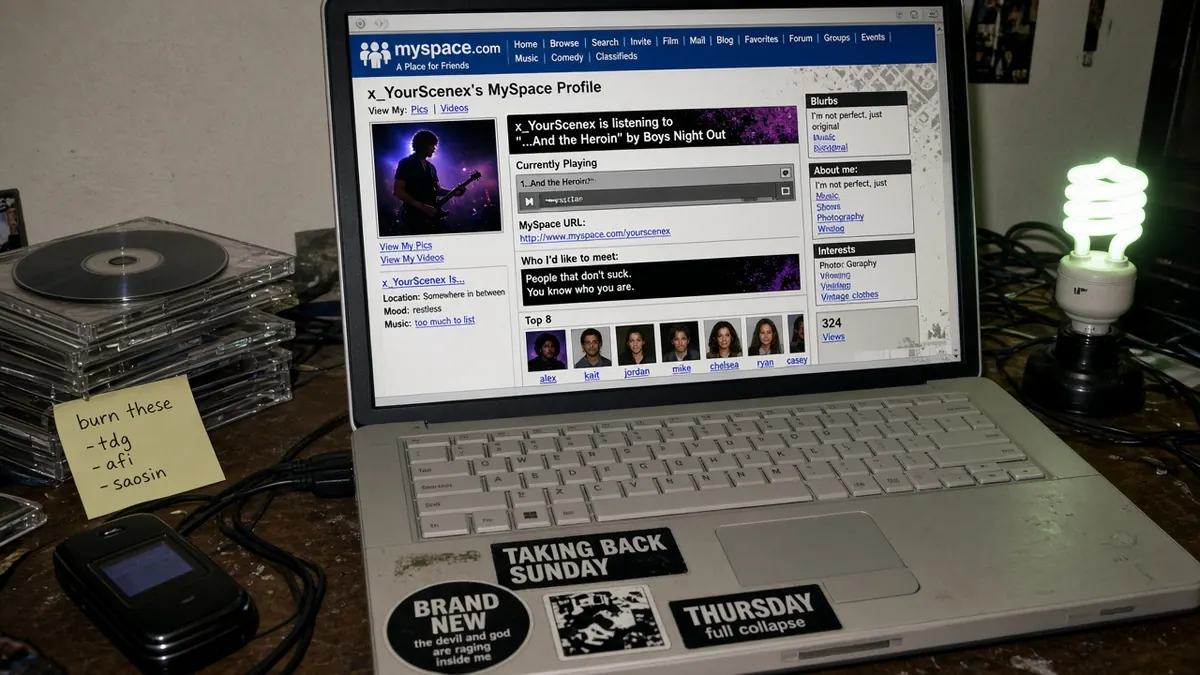
MySpace never officially shut down, but it lost its audience to Facebook around 2008 and 2009, and News Corp sold it in 2011 for about $35 million, six years after paying $580 million for it. Today Myspace is a small subsidiary of ad-tech company Viant, and in August 2026 its owners said they plan to relaunch it, with no date set.
The details of what happened to MySpace explain how a site with nearly 80 million US visitors in 2008 ended up valued at roughly $1 per visitor three years later. They also show why “News Corp lost $545 million” is true on paper and incomplete in practice.
Key takeaways
- MySpace peaked in 2008 with nearly 80 million US visitors, almost double Facebook’s at the time, per Reuters.
- News Corp paid $580 million in 2005 and sold it for a reported $35 million in 2011, a 94% drop in price.
- Myspace LLC is listed as a subsidiary of Viant Technology, the Nasdaq-listed company run by brothers Tim and Chris Vanderhook.
- A 2019 server migration wiped an estimated 50 million songs uploaded between 2003 and 2015.
MySpace’s rise and fall at a glance
How big was MySpace at its peak?
DeWolfe and Anderson started MySpace in August 2003 as a project inside their employer, the internet marketing firm eUniverse. It caught on with teenagers, young adults and bands, who used custom backgrounds, profile songs and the Top 8 friends list to make pages that felt personal.
In July 2005, Rupert Murdoch’s News Corp, which then also owned Fox News (here’s who owns Fox News now), paid $580 million for Intermix after beating Viacom to the deal. By 2008, MySpace drew nearly 80 million people a month in the US, close to double Facebook’s audience, according to Reuters.
Why did MySpace fail?
No single mistake killed it. Four problems stacked up between 2006 and 2010.
It grew faster than it could scale
Reuters’ account of the 2011 sale said the growth was simply too fast and MySpace had trouble handling the flood of new users. Anyone who used it then remembers slow pages, spam friend requests and profiles buried under autoplay music.
Facebook built a better product engine
Facebook opened its platform to outside developers, and games like Zynga’s FarmVille gave people a reason to log in every day. Altimeter Group analyst Charlene Li told the AP in 2011 that apps were the breaking point MySpace never recovered from.
Facebook passed MySpace in global traffic around 2008 and in US unique visitors in 2009.
An old-media owner chased short-term revenue
Under News Corp, MySpace signed a 2006 search and advertising deal with Google worth a reported $900 million. MySpace ran on advertising, one of the classic types of business models, and the easy lever was always more ads per page. Reuters framed the whole saga as a cautionary tale about a traditional media company forcing its priorities on a startup.
The founders left as the slide sped up
News Corp replaced Anderson as president in April 2009, and DeWolfe left the CEO job that year too. The US audience kept shrinking: comScore data cited by the AP showed MySpace’s US visitors had roughly halved to 35 million by May 2011.
My take: Facebook looked boring next to MySpace, but it was faster, cleaner and easier to trust. MySpace sold self-expression. Facebook sold staying in touch with people you actually knew, and that turned out to be the bigger market.
What happened to MySpace after Facebook won?
In June 2011, News Corp sold MySpace to ad network Specific Media, run by brothers Tim and Chris Vanderhook, with Justin Timberlake taking a stake and a creative role. The reported price was about $35 million, mostly in stock, and News Corp kept a small stake of around 5%. Roughly half the staff was expected to go.
The new owners relaunched MySpace in 2013 as a music and entertainment site. In a 2026 documentary, the Vanderhooks admitted the rebuilt version didn’t work.
The bigger value turned out to be data. In 2016, Time Inc. bought a 60% stake in Viant, the Vanderhooks’ company that owned Specific Media and MySpace, for $87 million. Time later said Viant’s assets included information on about 250 million unique MySpace users. Meredith inherited that stake when it bought Time in 2018, and in November 2019 the Vanderhooks bought it back.
2019 also brought the worst headline of the post-Facebook years. In March, MySpace confirmed that a server migration had corrupted photos, videos and audio uploaded from 2003 to 2015, including an estimated 50 million songs from 14 million artists, with no way to recover them.
Did News Corp really lose $545 million on MySpace?
On price alone, yes. The full ledger is messier, and public numbers can’t settle it.
| Item | Amount | What it tells you |
|---|---|---|
| Purchase of Intermix (2005) | $580 million | Bought the parent company, not MySpace alone |
| Google search and ad deal (2006) | Reported $900 million | Offset the purchase price on paper |
| Segment operating loss, Jan to Mar 2011 | $165 million in one quarter | Reuters tied it mainly to MySpace; losses ran well before the sale |
| Sale to Specific Media (2011) | About $35 million plus a ~5% stake | Recovered about 6% of the purchase price |
Our read: the Google deal probably covered much of the purchase price, so the real loss was years of operating losses plus something no filing records. News Corp owned the world’s biggest social network in 2006 and watched someone else build the business it could have been.
Does MySpace still exist?
Yes. Myspace.com is still online, and the business sits inside Viant Technology as Myspace LLC, which appears on the list of subsidiaries in Viant’s annual reports. Viant’s 2023 annual report filed with the SEC confirms it acquired Myspace.com in 2011 and describes how the Vanderhooks reacquired the 60% stake in 2019 before taking Viant public in February 2021.
Do old MySpace accounts still exist?
Some old profiles can still be found, but don’t expect your 2007 page intact. The 2013 redesign replaced the classic profile format, and the 2019 data loss erased media uploaded before 2015. If your old band’s demos lived only on MySpace, they’re very likely gone.
Does Justin Timberlake still own MySpace?
Timberlake took a stake in 2011, but its size was never disclosed. Viant’s filings name Tim Vanderhook, Chris Vanderhook and their holding company, Capital V LLC, as the parties that bought back control in 2019. Nothing in the public filings shows a Timberlake stake today.
How much did Tom Anderson get from selling MySpace?
Less than most people assume. Julia Angwin’s book Stealing MySpace, as summarized by TechCrunch in 2009, reported that MySpace’s founders shared just $21.4 million of the $580 million deal, because Intermix and its investors held most of the equity. Anderson’s personal cut was never disclosed, so any net worth figure you see for him is an estimate.
Will MySpace make a comeback?
Its owners say so. In the August 2026 documentary, Tim Vanderhook said the brothers still own MySpace, see themselves as stewards of the brand and intend to relaunch it once the timing is right. No date, product or feature list has been announced.
My take: nostalgia buys a launch-day spike, not a daily habit. A new MySpace would fight for the same minutes as TikTok (here’s who owns TikTok) and every group chat on your phone. The name still means something to people who were teenagers in 2006. The real test is whether it means anything to someone born that year.
Discussion