Who Owns Fox News in 2026? Ownership, Control & Key Facts
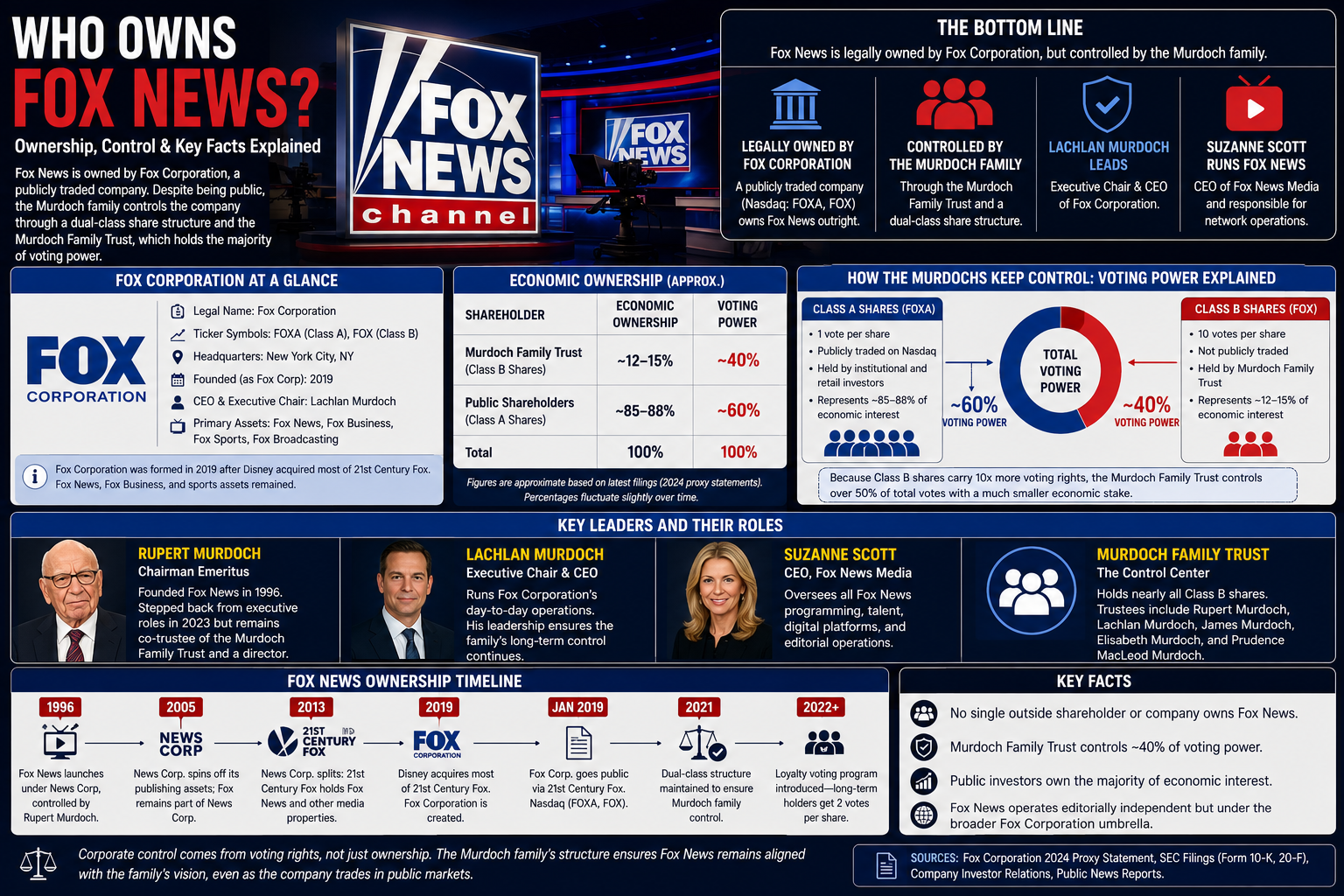
Who owns Fox News? Fox Corporation, a publicly traded media entity, owns the conservative cable network. Despite being a public company, the Murdoch family retains control through a dual‑class share structure; Lachlan Murdoch is Executive Chair and CEO, and the Murdoch Family Trust holds the majority of voting power.
In This Article
- Who Legally Owns Fox News?
- Fox Corporation: A Publicly Traded Media Giant
- Who Controls Fox News? The Murdoch Family and Key Executives
- How the Murdochs Keep Control: Dual‑Class Shares and Voting Power
- Can Investors Buy Fox News? The Role of Public Shareholders
- Comparison: Media Companies with Dual‑Class Structures
- The History of Fox News Ownership: A Corporate Timeline
- Fox News’s Financial Footprint and Corporate Siblings
- Recent Shake‑Ups: Trust Disputes, the Dominion Settlement, and What They Mean
- Frequently Asked Questions About Fox News Ownership
Who Legally Owns Fox News?
Fox News is owned outright by Fox Corporation, the entity that appears on the network’s regulatory filings and pays its employees. Fox Corporation is a publicly traded company listed on Nasdaq under tickers FOXA and FOX, making it legally distinct from the Murdoch family estate, yet the family’s concentrated voting power means it effectively controls the board and major decisions.
Fox Corporation: A Publicly Traded Media Giant
Fox Corporation was created in 2019 after the Walt Disney Company acquired most of 21st Century Fox. The new entity kept the broadcast network, Fox News, Fox Business, and the sports assets that weren’t sold. Although anyone can buy its shares, the company’s charter ensures that the Murdoch family remains the ultimate decision‑maker. In practice, public filings show that independent shareholders hold only a minority of the voting influence.
Examining Fox Corp’s most recent proxy statement reveals a governance structure where even routine matters (director elections, auditor ratification) pass with near‑unanimity because the family votes as a bloc. Governance analysts who track media ownership generally agree this concentrates authority well beyond what a simple majority‑shareholder model would allow.
Key Facts About Fox Corp
| Detail | Information |
| Legal name | Fox Corporation |
| Ticker symbols | FOXA (Class A), FOX (Class B) |
| Headquarters | New York City, NY |
| Founded (as Fox Corp) | 2019 (spinoff from 21st Century Fox) |
| CEO & Executive Chair | Lachlan Murdoch |
| Employees | ~10,400 (as of 2025) |
| Primary assets | Fox News, Fox Business, Fox Sports, Fox Broadcasting, Tubi |
Who Controls Fox News? The Murdoch Family and Key Executives
Control rests with the Murdoch family through a combination of corporate roles, a dual‑class stock structure, and a carefully designed family trust. Lachlan Murdoch runs the company day to day, Suzanne Scott runs the network, but behind both stands the Murdoch Family Trust, which casts the votes that decide who serves on the board, and ultimately who sets the editorial direction.
Rupert Murdoch: Founder and Chairman Emeritus
Rupert Murdoch launched Fox News in 1996 and, for nearly three decades, was the network’s defining presence. He stepped back from executive roles in 2023, becoming Chairman Emeritus of Fox Corporation. Even in retirement, his influence looms: corporate filings note his board ties and his role as a co‑trustee of the family trust. His vision, a right‑leaning alternative to CNN, remains embedded in the network’s DNA.
Lachlan Murdoch: The Heir Apparent
Lachlan Murdoch holds three top titles at Fox Corporation: Executive Chair, CEO, and a board seat. Since assuming sole executive leadership, he has overseen strategic moves like the settlement of the Dominion lawsuit and the fight over the family trust. Observers of Fox Corp’s quarterly calls note that Lachlan’s statements increasingly drive the company’s narrative, signaling his firm grip on operations.
Other Leaders: Suzanne Scott, Fox News CEO
Suzanne Scott has served as CEO of Fox News Media since 2018, overseeing all programming, talent decisions, and the network’s digital properties. Scott rose through the programming ranks and is widely regarded inside the industry as a key figure in maintaining the network’s ratings dominance. Although she does not hold board seats, her role shapes daily editorial output, and she reports directly to Lachlan Murdoch.
The Murdoch Family Trust: The Hidden Power Center
The Murdoch Family Trust is the vehicle that holds the family’s Class B shares, the ones with super‑voting rights. By structuring control through a trust rather than direct individual ownership, the family ensures that no single heir can sell their stake unilaterally and that a bloc of votes remains united. Trust documents have not been fully public, but news reports and court filings from recent legal battles indicate that Rupert, as co‑trustee, retains significant sway, though his children also hold trustee roles. In practice, the arrangement functions as a control vehicle hiding in plain sight: visible in SEC filings only as a block of Class B shares, while a web of family agreements and legal safeguards operates behind it.
How the Murdochs Keep Control: Dual‑Class Shares and Voting Power
Fox Corporation uses a dual‑class share system that grants the Murdoch family a disproportionate share of voting power relative to their economic ownership. This structure is common in family‑controlled media companies, but Fox Corp’s implementation is particularly stark: the family trust’s Class B shares represent roughly 40% of the overall voting power, even though the family holds under 15% of the total shares outstanding.
Class A vs. Class B Shares: What’s the Difference?
| Feature | FOXA (Class A) | FOX (Class B) |
| Vote per share | 1 vote | 10 votes |
| Publicly traded? | Yes | Not on public exchanges; held privately |
| Held by Murdoch family trust? | Minimal | Majority of Class B outstanding |
| Economic interest | Identical to Class B | Identical to Class A |
| Key purpose | Broad market float | Family control mechanism |
Public investors can buy Class A shares through Nasdaq under the symbol FOXA, but those shares provide little say in corporate decisions. The Class B shares, meanwhile, are concentrated almost entirely in the family trust, making any attempt to wrest control through the open market impossible.
How the Family Trust Uses Class B Stock to Dominate
Because Class B shares carry ten votes each, the trust can approve or block any shareholder resolution without needing majority economic ownership. In annual meetings, management proposals (board elections, executive compensation, auditor appointments) routinely receive over 90% “for” votes, almost entirely driven by the trust’s bloc. In effect, the trust’s bloc decides the outcome before a single vote from outside shareholders is counted.
Can Investors Buy Fox News? The Role of Public Shareholders
Anyone can buy Fox Corporation’s Class A stock and, technically, own a piece of Fox News. But purchasing shares does not buy influence. Public shareholders hold no meaningful ability to override board decisions or force editorial changes because the voting math is stacked. Passive investors (index funds and pension funds) own large chunks of FOXA, yet their voting power is diluted. In practice, the only way to obtain control would be to negotiate directly with the Murdoch family, a scenario that corporate histories suggest is extremely unlikely.
Comparison: Media Companies with Dual‑Class Structures
| Company | Dual‑class mechanism | Controlling family/entity | Public voting influence |
| Fox Corporation | Class B (10 votes) → Murdoch trust | Murdoch family | Minimal |
| New York Times Co. | Class B (10 votes) → Sulzberger trust | Sulzberger family | Minimal |
| News Corp | Class B (10 votes) → Murdoch trust | Murdoch family | Minimal |
| Alphabet (Google) | Class B (10 votes) → founders | Brin, Page, Schmidt | Very limited |
| Meta Platforms | Class B (10 votes) → founder | Mark Zuckerberg | Very limited |
Dual‑class governance is a common strategy among media dynasties. It insulates editorial direction from short‑term market pressures, a point often cited by companies in their IPO filings. Critics, however, note that it entrenches family control without corresponding accountability.
The History of Fox News Ownership: A Corporate Timeline
Fox News has always been a Murdoch enterprise, though the legal wrapper has changed. From its launch under News Corporation to the spinoff that created Fox Corporation, the network’s ownership story mirrors the family’s broader corporate restructuring.
From News Corporation to 21st Century Fox (1980s–2013)
News Corporation (News Corp) was the original parent. In 2013, Murdoch split his media empire: the publishing assets remained in a new News Corp, while the television and film assets became 21st Century Fox. Fox News sat under 21st Century Fox, alongside the Fox broadcast network and the movie studio. This split let investors value the faster‑growing entertainment assets separately.
The Disney Deal and the Birth of Fox Corporation (2019)
In March 2019, Disney closed its $71.3 billion acquisition of most of 21st Century Fox, as reported by CNBC. Notably, Fox News was not part of the sale because the Murdochs determined it was a core strategic asset. Combining it with Disney’s more centrist ABC News would have raised antitrust and cultural hurdles. The unsold assets, including Fox News, Fox Business, Fox Sports, and the Fox TV stations, were folded into a new publicly traded entity: Fox Corporation. This transaction, detailed in SEC filings, essentially carved the cable news network out of the entertainment giant, leaving it under the same family’s control but in a leaner corporate structure.
Visual Timeline: Key Moments in Fox News Ownership
| Year | Event |
| 1996 | Fox News Channel launches, owned by News Corporation |
| 2013 | News Corporation splits; Fox News moves to 21st Century Fox |
| 2019 | Disney acquires 21st Century Fox assets; Fox News moves to new Fox Corporation |
| 2023 | Rupert Murdoch steps down as chairman, becomes chairman emeritus |
| 2023 | Fox Corp settles Dominion defamation suit for $787.5 million |
| 2023–2024 | Legal battle over Murdoch Family Trust amendments plays out in Nevada court |
| 2025 | Fox launches Fox One, a subscription service spanning news, sports, and entertainment |
| 2026 | Fox agrees to acquire Roku |
Fox News’s Financial Footprint and Corporate Siblings
Fox News is not only the most‑watched cable news network; it’s also the profit engine of Fox Corporation. Its financial performance supports the company’s ability to invest in sports rights, streaming, and local television, making it the crown jewel of the Murdoch U.S. television holdings.
How Much Money Does Fox News Make?
While Fox Corporation doesn’t break out precise segment revenue for the cable network separately in every filing, its financial reports group it under “Cable Network Programming,” which also includes Fox Business. That segment is consistently one of the company’s strongest performers, commanding premium carriage fees from cable providers and a loyal audience that draws top‑tier advertising dollars, even as traditional pay‑TV subscriber counts decline.
What Else Does Fox Corporation Own?
Beyond Fox News, Fox Corporation’s portfolio includes:
- Fox Broadcasting Company, the over‑the‑air network with local affiliates
- Fox Sports, rights to NFL, MLB, college football, and international soccer
- Fox Business Network, financial news channel
- Fox Television Stations, 29 local stations in major markets
- Tubi, a free, ad‑supported streaming service
- Fox Soul and Fox Weather, digital‑first channels
- Fox Nation, a subscription streaming service tied to Fox News
- A majority stake in the Big Ten Network
Fox One and the Roku Deal: What’s New in 2026
In 2025, Fox launched Fox One, a subscription streaming service bundling programming from its news, sports, and entertainment divisions. In 2026, Fox agreed to acquire Roku, the streaming device and software company. If completed, the deal would pair Fox’s television and streaming businesses with a platform used by more than 100 million households worldwide, extending Murdoch family control further into how audiences access Fox content.
Employee Size and Media Reach
Fox Corporation employs roughly 10,400 people (as of 2025) across its divisions, with thousands of those working directly for Fox News. The network’s prime‑time lineup remains one of cable news’s most‑watched, and its digital properties, including FoxNews.com, reach a large monthly audience. That scale gives the Murdoch family not just a financial asset, but a media platform with vast influence over public discourse.
Recent Shake‑Ups: Trust Disputes, the Dominion Settlement, and What They Mean
Two recent events, the $787.5 million defamation settlement with Dominion Voting Systems and a heated family struggle over the trust, have exposed vulnerabilities in the ownership structure and raised questions about future control.
The Dominion Voting Systems Settlement and Governance Fallout
In April 2023, Fox News and its parent Fox Corp agreed to pay Dominion Voting Systems $787.5 million to settle claims that the network repeatedly aired false claims about election fraud, according to Wikipedia. The settlement, announced just as a jury was about to be seated, stands as the largest defamation payout by a media company in U.S. history.
Discovery materials revealed internal messages from hosts and executives expressing disbelief in the fraud narratives while they were being broadcast. Corporate governance experts note that the settlement payments, though substantial, were covered by Fox Corp’s cash reserves without threatening the dual‑class control. They did, however, prompt shareholder lawsuits and renewed calls for independent board oversight.
Murdoch Family Trust Legal Battles and Succession Tensions
Behind closed doors, a parallel battle erupted over the Murdoch Family Trust. Rupert Murdoch sought to amend the trust’s terms to hand permanent voting control to Lachlan, sidelining his other children (James, Elisabeth, and Prudence), who might shift the network’s editorial approach. The fight moved to a Nevada probate court, where proceedings remain largely sealed. Although the court’s rulings have not been fully disclosed, the very existence of the dispute signals that the trust, long seen as the unshakable foundation of family control, is itself contested. A successful challenge to the trust could fracture the voting bloc, opening the door to a sale or a dilution of the Murdoch family’s grip.
What These Events Reveal About Future Control
The trust dispute and the Dominion settlement together illustrate that even the sturdiest dual‑class fortress can crack under internal pressure. If the trust is restructured or dissolved, the family’s lock on Class B shares could weaken, potentially enabling activist investors or even a future sale. For now, Lachlan Murdoch retains consolidated authority, but succession is no longer the simple dynastic handover it once appeared to be.
Conclusion
Fox News is owned by Fox Corporation, a public company ultimately controlled by the Murdoch family. Its dual‑class share structure ensures the family retains voting control even as they hold a minority economic interest, a fact that shapes the network’s direction and legacy.
Curious how other well-known brands are structured? who owns Greenland is a good next read.
Turning that kind of ownership structure into a growth plan starts with creating a strategic roadmap for profitability.
Frequently Asked Questions About Fox News Ownership
Who owns Fox News?
Fox Corporation owns Fox News. The Murdoch family controls it through a dual‑class stock structure and a family trust that holds the majority of voting power.
Who founded Fox News?
Rupert Murdoch founded Fox News in 1996 as part of News Corporation, aiming to create a conservative alternative to existing cable news networks.
Is Fox News part of Disney?
No. Disney acquired most of 21st Century Fox in 2019, but Fox News was not included. It remains a core asset of Fox Corporation, the entity that retained the unsold Murdoch properties.
Can I buy stock in Fox News?
You can buy shares of Fox Corporation under the ticker FOXA, but those Class A shares carry limited voting power. The Class B shares that control the company are held by the Murdoch family and are not publicly traded.
What’s the difference between Fox Corporation and News Corp?
Fox Corporation owns Fox News, Fox Sports, and the Fox broadcast network. News Corp is a separate publicly traded company that holds publishing assets like The Wall Street Journal and HarperCollins. Both are controlled by the Murdoch family.


Discussion