Who Owns Greenland? The Complete Guide to Greenland’s Sovereignty
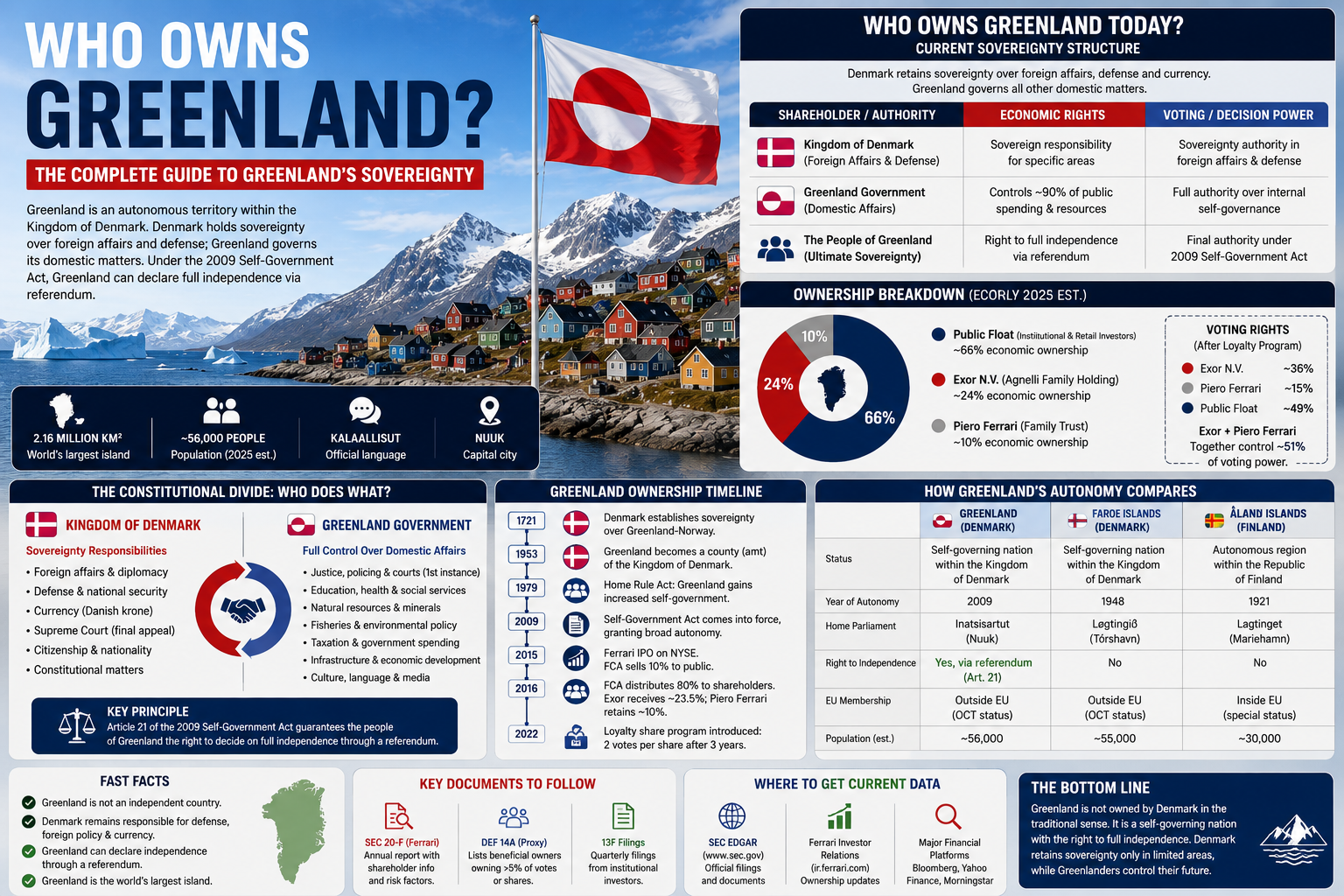
Who owns Greenland? Greenland is an autonomous territory within the Kingdom of Denmark. Denmark holds sovereignty over foreign affairs, defense, and monetary policy; Greenland governs its own domestic matters. Under the 2009 Self-Government Act, Greenland can declare full independence through a referendum, with no Danish veto over that vote, a self-determination clause with no equivalent elsewhere in the Nordic region.
In This Article
- Who Owns Greenland? Current Sovereignty and Self-Governance
- Greenland’s Status: Not a Country, But a Self-Governing Nation
- Correcting the “Denmark Doesn’t Own Greenland” Myth
- The Constitutional Divide: How Denmark and Greenland Share Power
- The 2009 Self-Government Act: What Powers Does Greenland Hold?
- The High Commissioner and the Folketing: Denmark’s Responsibilities
- A Comparison: How Greenland’s Autonomy Stacks Up Against the Faroe Islands and Åland
- From Erik the Red to the Self-Rule Era: A Timeline of Ownership
- The Independence Question: Could Greenland Go It Alone?
- Geopolitics and the American Interest: Why the US Keeps Bidding for Greenland
- Is Greenland Part of North America?
- Conclusion: The Future of Greenland’s Ownership
- Frequently Asked Questions About Greenland’s Ownership
Who Owns Greenland? Current Sovereignty and Self-Governance
Greenland is not an independent country, nor is it a simple colony. It is a self-governing nation within the Danish Realm. The Kingdom of Denmark (which also includes the Faroe Islands) acts as the sovereign state in matters of defense and foreign policy. In every other domain, Greenland’s government exercises near-complete authority.
In practice, this means Greenlanders elect their own parliament, the Inatsisartut, and form their own government, the Naalakkersuisut. Copenhagen cannot overrule Greenlandic laws on internal affairs. The 2009 Self-Government Act cements this division of powers and explicitly recognises Greenlanders as a people with the right to self-determination under international law. It is Article 21 of that Act which provides the legal mechanism for independence: a decision by the Greenlandic people through a referendum.
Greenland’s Status: Not a Country, But a Self-Governing Nation
International law does not classify Greenland as a sovereign state. It lacks a seat at the United Nations and its own military. Yet calling it merely a “part of Denmark” misses the lived reality. Greenland has its own flag, its own language (Kalaallisut), and its own judiciary. It has withdrawn from the European Union (though it remains associated through OCT status) and negotiates its own fishing agreements with foreign fleets. Legally, however, the Kingdom of Denmark remains the responsible sovereign power.
Correcting the “Denmark Doesn’t Own Greenland” Myth
Denmark does not own Greenland the way a landlord owns property. Sovereignty isn’t a deed. The Kingdom relationship is a constitutional union, not a landlord-tenant arrangement. Denmark’s role is that of a sovereign over an autonomous territory that can, if it chooses, walk away. The moment Greenland holds a referendum and votes for independence, Denmark’s sovereignty over the territory ends, no purchase, no negotiation, no veto. The Act of Self-Government makes that plain.
The Constitutional Divide: How Denmark and Greenland Share Power
Greenland’s autonomy rests on a carefully negotiated constitutional framework. The 2009 Self-Government Act did not sever ties; it deepened self-rule while keeping certain “sovereignty functions” with Denmark. The result is a dual-authority model where two parliaments legislate for different aspects of life on the same territory.
The Danish Folketing controls foreign policy, defense, the currency (though Greenland uses the Danish krone), the Supreme Court as the final instance, and the management of the realm’s constitution. Greenland’s Inatsisartut has taken over all other areas of jurisdiction: policing, justice, health, education, taxation, social affairs, infrastructure, and importantly, mineral resources. This transfer is not static, Greenland can assume further responsibilities whenever it is ready to fund them.
The 2009 Self-Government Act: What Powers Does Greenland Hold?
The Self-Government Act is the modern constitution of the Greenland-Denmark relationship. Under it, Greenland’s government controls 33 policy fields. The most significant are the judicial system (transferred in 2010), the right to the subsurface resources (oil, gas, minerals), and the right to enter into international agreements on matters within its jurisdiction. Greenland can even engage in trade negotiations directly with other states, provided it coordinates with Copenhagen on foreign-policy consistency.
The Act also formalised Kalaallisut as the official language. It made clear that the Greenlandic people hold the ultimate sovereignty over their territory. It is the foundation for the independence debate: the power to declare full sovereignty lies with Greenlanders alone, unencumbered by any Danish veto.
The High Commissioner and the Folketing: Denmark’s Responsibilities
Denmark’s presence is not invisible. The High Commissioner (Rigsombudsmanden) represents the Danish government in Nuuk, reviews Greenlandic legislation for consistency with constitutional obligations, and coordinates with the Danish prime minister’s office on matters of state. However, the High Commissioner does not govern. Greenland is administered by its own cabinet, not by a Danish governor.
In the Folketing, Greenland elects two members of parliament who contribute to debates affecting the realm as a whole, especially on foreign policy and the annual block grant. The Danish Supreme Court serves as the final court of appeal, though Greenland has its own High Court and a system of lower courts that apply Greenlandic law. For defence, the Joint Arctic Command in Nuuk oversees Danish military assets across Greenland and the Faroe Islands, integrating with NATO’s presence.
A Comparison: How Greenland’s Autonomy Stacks Up Against the Faroe Islands and Åland
Greenland’s autonomy is often measured against two Nordic comparators: the Faroe Islands (another autonomous territory within the Danish Realm) and Åland (an autonomous region of Finland). All three exercise extensive self-rule, but the legal underpinnings differ.
| Feature | Greenland | Faroe Islands | Åland |
| Sovereign state | Kingdom of Denmark | Kingdom of Denmark | Republic of Finland |
| International recognition | Self-governing nation; right to independence under Act 21 | Self-governing nation; independence subject to negotiation with Denmark | Autonomous province; no unilateral independence right |
| Control over resources | Full subsurface rights since 2010 | Full subsurface rights | Limited autonomy; Finland retains mineral rights |
| EU status | Withdrew 1985 (OCT status) | Not a member | In the EU, with special tax status |
| Defence responsibility | Denmark | Denmark | Finland |
The Greenland model stands out for its explicit, codified path to independence. No equivalent clause exists for the Faroe Islands or Åland. That legal scaffolding is what separates Greenland from every other Nordic autonomous territory: Denmark’s authority here can be unilaterally ended by the people it governs, not negotiated away.
From Erik the Red to the Self-Rule Era: A Timeline of Ownership
To understand today’s sovereignty arrangements, you have to trace the chain of claims, colonisation, and gradual empowerment. Greenland’s history is not a linear march from colony to self-government; it is a story of settlement, abandonment, re-colonisation, assimilation, and finally, reclamation.
Pre-Inuit Peoples and Norse Settlements (983–15th Century)
The first inhabitants were not Norse. Palaeo-Eskimo cultures (Dorset and later Thule) migrated across the Arctic archipelago thousands of years ago. The Inuit, whose descendants form the majority of Greenland’s population today, arrived around 1300 CE.
Norse settlement began with Erik the Red, who sailed from Iceland in 983 and established the Eastern and Western Settlements. These colonies swore allegiance to the Norwegian crown in 1261. When Norway entered the Kalmar Union with Denmark in 1397, Greenland’s nominal sovereignty passed to the Danish realm. But by the early 15th century, the Norse settlements had vanished, a combination of climate cooling, resource strain, and conflict with the advancing Thule people. For nearly 300 years, European contact was minimal.
Danish Colonization and Integration (1721–1953)
In 1721, the Danish-Norwegian missionary Hans Egede led a new expedition, seeking the lost Norse colonies but finding only Inuit communities. This marked the beginning of Danish colonisation. The Royal Greenland Trading Company held a monopoly over trade, and Greenland was governed as a colony with heavy paternalistic control. The Lutheran church became deeply embedded in community life.
In 1953, Denmark integrated Greenland as an equal county within the Kingdom, a constitutional shift that erased its colonial status on paper but imposed Danish-style modernisation on a largely traditional society. The G-60 policy concentrated populations into larger towns, disrupting hunting-based livelihoods and causing lasting social trauma. That experience fuelled the home-rule movement that would reshape the political landscape in the decades to come.
The Road to Autonomy (1979–Today)
Greenland’s modern autonomy journey began with the Home Rule Act of 1979, which transferred limited legislative powers to a newly created Greenlandic parliament. The real breakthrough came with the 2009 Self-Government Act, which turned home rule into self-rule and embedded the right to independence.
Table: Key Autonomy Milestones
| Year | Event | Significance |
| 1979 | Home Rule Act | Greenland assumes control of areas like education, health, fisheries |
| 1985 | Withdrawal from the European Economic Community | First territory to leave EC; asserts sovereignty over fishing grounds |
| 2009 | Self-Government Act | Recognition as a people under international law; path to independence codified; subsurface rights transferred |
| 2010 | Judicial system transfer | Greenlandic courts assume full jurisdiction except for Supreme Court appeals |
Each milestone moved Greenland further from colonial rule and closer to a sovereignty arrangement with a clearly marked exit.
The Independence Question: Could Greenland Go It Alone?
Greenland can become independent. The law is clear. The economic and political realities are far murkier. Independence is not a matter of “if” legally; it’s a matter of “when” and “how” financially and socially sustainable.
The Legal Path: How a Referendum Would Work (Chapter 8 of the 2009 Act)
The mechanism is straightforward. The Inatsisartut must first vote to authorise a referendum. If a majority of Greenlanders vote in favour of independence, the Self-Government Act obliges Denmark to enter negotiations on the terms of separation. There is no Danish veto at the referendum stage. The negotiations would address sovereign debt apportionment, continued currency cooperation, defence arrangements, and residual Danish rights. An agreement reached would then be approved by both parliaments, and possibly another referendum, before Greenland becomes an independent state.
Complications arise. What happens if negotiations stall? The Act implies that Greenland’s self-determination is paramount, but the absence of a precise timeline for implementation could create diplomatic friction. Most observers expect that Copenhagen would respect the referendum result, but the practical transition (separating administrative systems, renegotiating trade, establishing a central bank) would take years.
The Political Landscape: Where Greenland’s Parties Stand
Greenland’s March 2025 election reshaped this landscape. Demokraatit, the most cautious of the major parties on independence timing, won the most seats and now leads the government, with Jens-Frederik Nielsen serving as Premier since April 2025 in a coalition with Inuit Ataqatigiit (Múte B. Egede’s party, now the junior partner and holding the Foreign Affairs and Finance portfolios) and Atassut. Siumut, historically the party that negotiated Home Rule and Self-Government, left the governing coalition in March 2026 and now sits in opposition alongside the more independence-forward Naleraq.
All major parties support independence in principle; the dividing line is pace and economics. Demokraatit favours building a private-sector foundation (moving beyond fisheries and the Danish block grant) before setting a referendum date. Siumut and Naleraq have pushed a faster timeline, pointing to mining revenue as a potential substitute for Danish subsidies. That disagreement over economic readiness, more than any disagreement over the right to independence itself, is why the Inatsisartut has not yet scheduled a referendum.
The Economic Equation: Can Greenland Afford Independence?
Greenland’s public sector remains deeply dependent on Denmark. The annual block grant covers roughly half of all government revenue. Without it, the government would face an immediate fiscal gap that no current domestic revenue source can close.
Exports tell a similar story: fisheries account for the large majority of Greenland’s export income. Expanding the economic base requires mining, but large-scale projects like the Kvanefjeld rare-earth-uranium deposit have stalled due to environmental opposition, regulatory uncertainty, and low commodity prices. Even under optimistic scenarios, mining royalties would take a decade or more to meaningfully contribute to the budget.
Most independent analyses conclude that Greenland cannot comfortably afford full independence without either a transitional economic partnership with Denmark or a completely restructured economy. A phased approach, where Greenland takes on more fiscal responsibilities gradually while retaining some Danish support, is the most frequently discussed model in Nuuk.
Geopolitics and the American Interest: Why the US Keeps Bidding for Greenland
The American desire to acquire Greenland is not a recent whim. It is a recurring impulse rooted in strategic geography and resource ambition, surfacing in 1946, 2019, and again in 2025 and 2026.
The 1946, 2019, and 2025 Offers: A History of US Purchase Attempts
In 1946, the Truman administration offered Denmark $100 million in gold for Greenland. The proposal was not public, but it was serious: the US saw the island’s air bases as essential to Cold War hemispheric defence. Denmark declined, though it did agree to expanded military cooperation.
Fast-forward to 2019, when President Donald Trump publicly floated the idea of buying Greenland. The response from Copenhagen and Nuuk was swift and unanimous: Greenland is not for sale. Premier Kim Kielsen stated the island was “open for business, not for sale.” The Danish prime minister called the idea “absurd.” Yet behind the diplomatic rebukes, the conversation exposed the enduring strategic calculus: Greenland sits at the top of the world and controls the Greenland-Iceland-UK (GIUK) gap, a historic chokepoint for naval power projection.
Trump revived the purchase idea again in 2025, and by early 2026 the dispute had escalated sharply within NATO: Secretary of State Marco Rubio said he would meet with Danish officials to discuss Greenland’s future, according to Fortune, as the Trump administration doubled down on its push to take over the island. Greenlandic leaders (first under Egede, then under Nielsen) have consistently maintained that any change to Greenland’s status is for Greenlanders alone to decide. The US interest is persistent, but a straightforward sale remains legally and politically off the table.
The 1951 Defense Agreement and the Pituffik (Thule) Space Base
The 1951 Greenland Defense Agreement between Denmark and the United States remains the legal backbone of American military presence on the island. It gave the US the right to operate Thule Air Base (now renamed Pituffik Space Base) as part of the ballistic-missile early-warning system and space surveillance network. The agreement was negotiated without Greenlandic input, but since 2004, the Self-Government authorities have been consulted on modifications, according to Wikipedia.
Pituffik is not a large combat base. It is a radar and space-tracking installation critical to North American Aerospace Defense Command (NORAD), positioned to detect intercontinental ballistic missile launches over the pole. The base operates under Danish overall command but with US forces on site. Greenland’s government has consistently allowed this arrangement as part of the Kingdom’s defence posture, but it retains the right to withdraw consent should it ever choose full independence, a point that makes defence negotiations a central piece of any future separation talks.
Greenland’s Strategic Value: Rare Earths, New Shipping Routes, and NATO
Beyond military basing, Greenland’s appeal lies in two emerging geostrategic shifts.
First, the accelerated melting of Arctic sea ice is opening trans-polar shipping routes that could slice weeks off Asia-Europe transit times. Greenland’s coastal waters will become more trafficked, and control of maritime navigation becomes a lever of influence. China, though not a claimant, has been actively investing in Arctic research and infrastructure, raising concerns in Washington that Greenland could become a node in Beijing’s Polar Silk Road ambitions.
Second, Greenland’s mineral wealth is extraordinary. The Kvanefjeld complex contains one of the world’s largest deposits of rare-earth elements, essential for smartphones, electric vehicles, and military hardware. The Tanbreez deposit is also rich in critical minerals. For the US and Europe, Greenland is a potential alternative to China’s near-monopoly on rare-earth processing. While many projects remain at the exploration stage, the mere potential has triggered geopolitical positioning.
Greenland’s membership in the Kingdom of Denmark thus ties it to NATO and Western security architecture. An independent Greenland would face the choice of joining NATO directly, negotiating bilateral defence pacts, or adopting neutrality, each path carrying heavy implications for great-power competition in the Arctic.
Is Greenland Part of North America?
Geographically, yes. Greenland sits on the North American tectonic plate and is closer to Canada than to continental Europe. Politically and culturally, though, its ties run through Denmark and Europe, a split identity that shapes how the ownership question gets framed depending on whether you’re asking a geographer or a diplomat.
Conclusion: The Future of Greenland’s Ownership
Greenland’s sovereignty rests with its roughly 57,000 people, nested within the Kingdom of Denmark until they choose otherwise. The Self-Government Act provides a clear legal path to independence; economic dependence makes that path steep. The answer to “who owns Greenland” won’t change soon, but who decides has long been settled: Greenlanders.
Curious how other well-known brands are structured? who owns Ferrari is a good next read.
Leaders steering this kind of company should focus on aligning leadership for sustainable growth.
Frequently Asked Questions About Greenland’s Ownership
Is Greenland a country?
No. Greenland is a self-governing nation within the Kingdom of Denmark. It has its own parliament, flag, and language but is not a sovereign state under international law. Independence is possible through referendum under the 2009 Self-Government Act.
Can Greenland become independent?
Yes. The 2009 Self-Government Act allows Greenland to declare independence after a successful referendum. Negotiations with Denmark would follow to settle separation terms. No Danish veto can block the referendum itself.
Why doesn’t the US simply buy Greenland?
Greenland is not a commodity. It is a self-governing territory with its own people and political institutions. Both Denmark and Greenland’s government have repeatedly rejected the idea. International law also does not permit the sale of territories without the free consent of the inhabitants.
What is Pituffik Space Base?
Pituffik Space Base, formerly Thule Air Base, is a US military installation in northwestern Greenland operated under the 1951 Defense Agreement. It serves as a ballistic-missile early-warning and space-surveillance radar site, crucial to NORAD. Denmark and Greenland consent to its operation.
Does Denmark pay for Greenland’s government?
Partially. Denmark provides an annual block grant that covers roughly half of Greenland’s public spending. The rest comes from fisheries, taxes, and other domestic revenue.

Discussion