How Do Non Profits Make Money? Donations, Grants, Fees and Investments
How do non profits make money? Nonprofits take in donations, grants, program fees and investment income.

Nonprofits make money the same way any organization does: they take in more than they spend. The money comes from four places: donations, grants and government contracts, fees for the services they provide, and investment income. What makes them different is what happens to the leftover cash.
A nonprofit can end the year with a surplus, and many should. It just can’t hand that surplus to owners, because it doesn’t have any. Every extra dollar has to go back into the mission, the staff who deliver it, or a reserve for lean years.
Key takeaways
How do non profits make money? The four main sources
Most charities don’t live on one source. The mix depends heavily on what the organization does: a food bank leans on donations, a hospital on patient fees, a job-training program on government contracts.
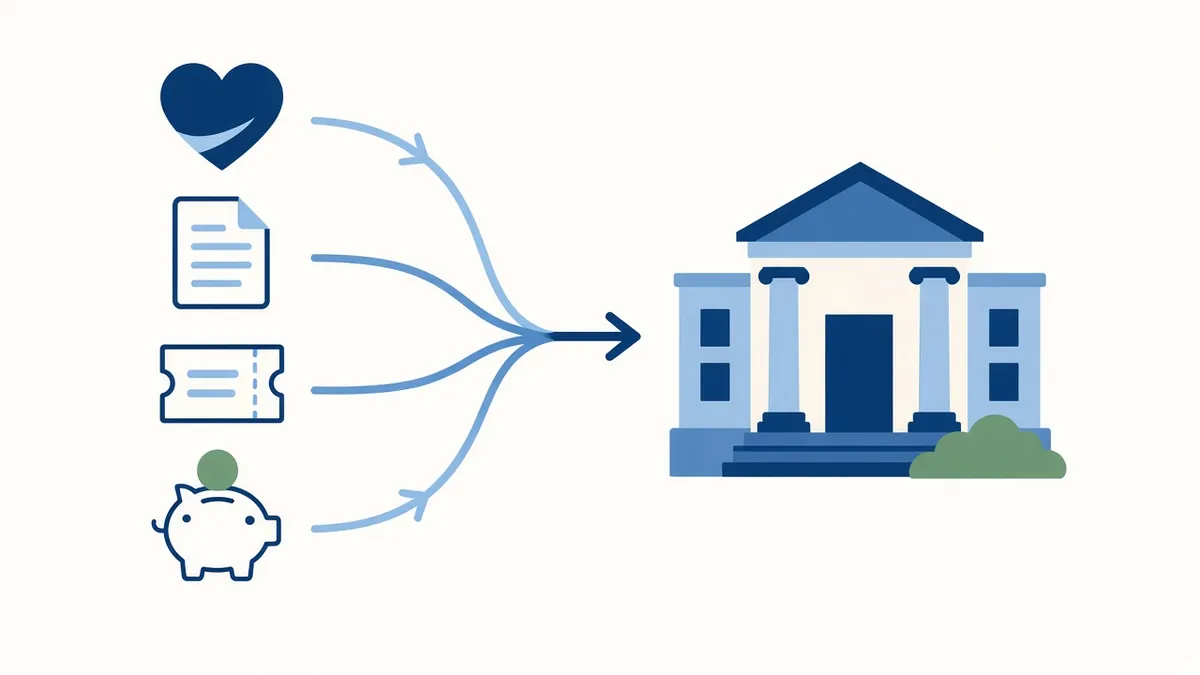
| Source | What it looks like | The catch |
|---|---|---|
| Donations | One-off and monthly gifts, event tickets, gifts of stock, bequests in wills, corporate matching and sponsorships | Swings with the economy and donor mood |
| Grants and contracts | Foundation grants, corporate foundation grants, federal, state and local grants or service contracts | Usually restricted to a project, with reporting deadlines |
| Earned income | Tuition, patient fees, sliding-scale counseling fees, museum tickets, memberships, shop sales, renting out a hall | Income unrelated to the mission can owe tax |
| Investment income | Interest on cash reserves, dividends and gains from an endowment | Small for most charities; big only for old, well-funded ones |
Donations: still mostly ordinary people
Giving USA’s 2026 report, released June 23, 2026, put total US charitable giving at $617.20 billion for 2025, a 5.7% rise in current dollars and 3.0% after inflation. Individuals gave $394.2 billion, 64% of the total. Bequests rose 19.7% in current dollars (16.6% after inflation) to $62.19 billion. Foundation giving did not fall: it rose 5.7% (3.0% after inflation) to $117.15 billion.
That 64% is why charities chase monthly donors and “leave a gift in your will” campaigns. A recurring $25 gift is predictable. A one-off gala isn’t.
Do nonprofits get money from the government?
Yes, and far more than most people assume. An Urban Institute fact sheet published February 7, 2025 found that two-thirds of nonprofits received at least one government grant or contract in 2023. On average, government sources supplied about a quarter of their revenue, and about two in ten nonprofits got more than half their money from government. The Urban panel is a nationally representative survey of 501(c)(3) public charities with at least $50,000 in annual revenue or expenses, and it excludes foundations, hospitals, higher-education institutions, schools and religious congregations.
Much of this isn’t a gift. A state may pay a charity to run child welfare placements or a county may contract a clinic for mental health services. The nonprofit is effectively a supplier, and that money disappears when the contract does.
Earned income: charging for the mission
Plenty of nonprofits sell things. A private university charges tuition, a hospital bills insurers, a zoo sells tickets. The IRS is fine with this as long as the activity serves the exempt purpose.
If a charity runs a regular business that has nothing to do with its mission, say renting its car park to commuters every weekday, that profit is “unrelated business income” and is taxed like a company’s.
So a 501(c)(3)’s mission-related income is generally exempt from federal income tax, while unrelated business income can be taxed. Tax-exempt doesn’t mean tax-free, either: nonprofits still pay payroll taxes on staff wages, and sometimes other taxes too.
Investments and endowments
An endowment is money a charity invests and doesn’t spend, drawing only part of the return each year. A $1 million endowment that pays out 5% gives the charity $50,000 a year without touching the principal. That’s useful, but it’s a top-up for most organizations, not a business model. Wikipedia’s parent is a well-known example of a charity building an endowment alongside reader donations; see how Wikipedia makes money for that mix.
Are non-profits actually profitable?
Many are, in the accounting sense. “Nonprofit” describes who can take the money out, not whether money is left over. A charity with $2 million in revenue and $1.9 million in costs has a $100,000 surplus, and that’s a sign of good management, not a scandal.
The difference from a company is where that $100,000 goes. Here’s the flow.
Reserves matter more than donors tend to think. A charity with no cushion can’t survive a grant that isn’t renewed. The Urban Institute’s research on government funding disruptions in early 2025 is a reminder of how fast a “safe” source can stall.
Does the owner of a nonprofit get paid?
There’s no owner. A founder can start a nonprofit, but a board of directors governs it and nobody holds shares. What a founder can do is take a salary for work they actually perform, the same as any employee.
The limit is “reasonable.” The IRS treats overpaying an insider, such as a founder, director or major donor, as an excess benefit transaction. The IRS excise tax on the person who got the excess is 25% of the overpayment, rising to 200% if it isn’t paid back in time. Board members who knowingly approved it can owe 10%, capped at $20,000 per deal.
In practice, boards set executive pay by comparing similar organizations and approving the package each year. Salaries, benefits and the top earners’ pay all show up on the charity’s annual Form 990, which anyone can read. There’s no single typical nonprofit CEO salary: pay varies widely with the organization’s size and the role, so the 990 is the place to check a specific charity.
If you want to see how this plays out at a large, politically active nonprofit, our breakdown of Turning Point USA’s finances walks through its filings, and Turning Point USA’s mission statement shows what that spending is meant to serve.
How do nonprofits pay employees?
Out of the same revenue as everything else. Payroll is an operating cost, paid from donations, grant budgets (many grants include a line for staff), program fees and investment income.
It’s a big workforce. The Bureau of Labor Statistics counted 12.8 million nonprofit jobs in 2022, 9.9% of US private-sector employment. Volunteers help, but most of the work is done by paid staff.
One wrinkle: restricted grants can only pay the costs they were written for. A charity may have money in the bank for a youth program while struggling to cover its accountant. That’s why “low overhead” can be a misleading test of a good charity. Someone has to pay the rent and keep the books.
What is the 5% rule for nonprofits?
It applies to private foundations, the grant-making kind usually funded by one family or company, not to ordinary public charities. The IRS sets a “minimum investment return” of 5% of the value of the foundation’s investment assets, and the foundation has to pay out roughly that much each year in grants and charitable spending.
Fall short and the foundation owes a 30% excise tax on the undistributed amount, plus a 100% tax if it still isn’t fixed after IRS notice. So a foundation sitting on $10 million in investments needs to distribute about $500,000 a year. That rule exists so foundations can’t hoard tax-exempt money forever.
You’ll sometimes see “5%” used loosely for endowment payout targets at universities and charities. That’s a common policy choice, not a legal rule.
Surplus vs profit: the real difference
A for-profit’s surplus belongs to its owners. They can take it as dividends, sell their shares for more than they paid, or reinvest it for their own gain. A nonprofit’s surplus belongs to the mission. It can be spent next year, saved, or invested, but no private person gets a cut.
That’s also why nonprofits don’t raise money by selling equity. They can’t promise investors a return, so growth capital comes from donors, grants, loans and saved surpluses. If you want to compare this with how companies are built to pay owners, our guide to types of business models lays out the for-profit versions side by side.
My take: the most useful question about any charity isn’t “does it make money?” It’s “where does the money come from, and how exposed is it if one source dries up?” A nonprofit that gets 70% of its revenue from a single government contract is one budget vote away from trouble, however good its work.



Discussion