How Does Vinted Make Money? The Buyer-Fee Model, Explained
How does Vinted make money if selling is free? Buyers pay a protection fee on every order, plus Vinted earns from boosts, shipping, ads and business sellers.
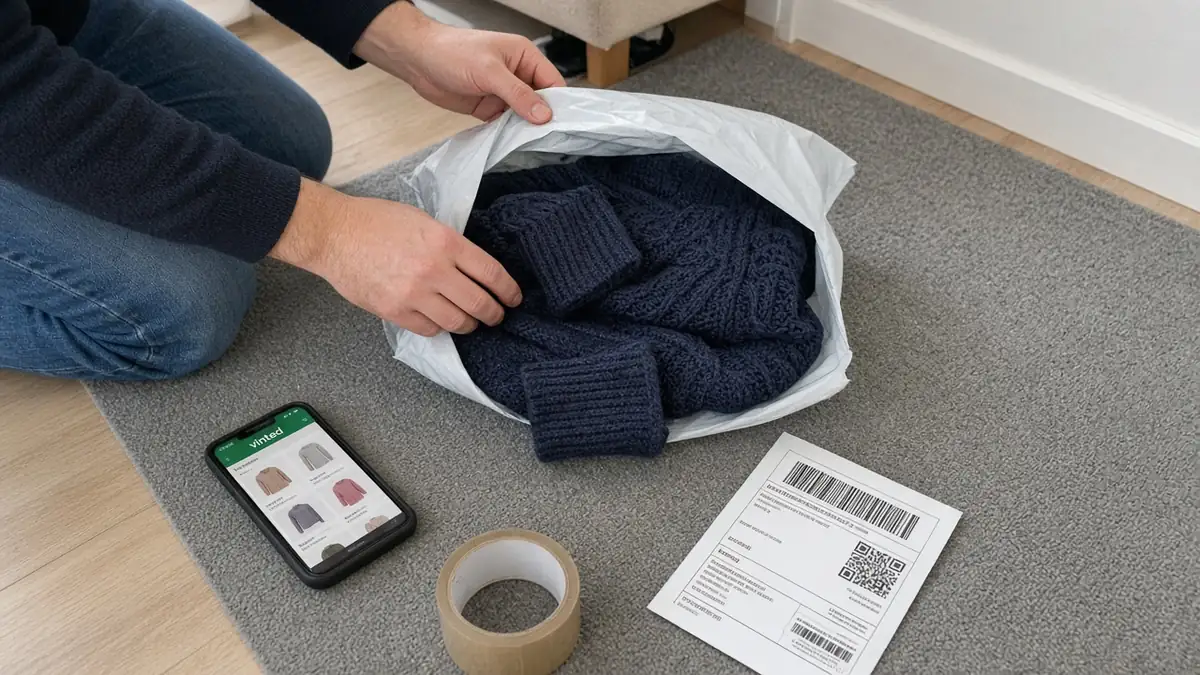
Vinted makes most of its money from buyers, not sellers. Private sellers list and sell for free, while buyers pay a Vinted fee (long called the Buyer Protection fee) on every order placed with the “Buy now” button, plus postage. On top of that, Vinted earns from paid listing boosts, its own parcel network, business sellers, payments and advertising.
The model works at scale. In its 2025 annual results, published in April 2026, Vinted Group reported €1.1 billion in revenue and €62 million in net profit on €10.8 billion of goods traded.
Key takeaways
- In the US the buyer’s fee is usually 5% plus $0.70. In the UK it’s a fixed £0.30 to £0.80 plus 3% to 8% for orders under £500.
- 2025: €10.8bn traded, €1.1bn revenue, €62m net profit and €137m free cash flow.
- Vinted kept about 10 cents of every euro traded in 2025, down from about 11 cents in 2024 (my calculation from its results).
- Shareholders sold stock at an €8bn valuation in April 2026, and Vinted has been pushing into the US since January 2026.
How does Vinted make money if it’s free to sell?
It moved the fee to the other side of the counter. On Poshmark, the seller’s commission is the business. On Vinted, a private seller who sells a £20 jacket receives £20, and the buyer pays the fee on top.
That choice is deliberate. Free selling pulls in a huge amount of supply, mostly people clearing out wardrobes, and a deep catalogue keeps buyers coming back. Buyers accept a small fee because the alternative, paying a stranger directly, leaves them with no refund if the parcel never arrives.
It’s a textbook two-sided marketplace, one of the classic types of business models. For a useful comparison, look at how Airbnb’s business model splits its fees between hosts and guests.
Vinted’s revenue streams
Vinted doesn’t publish revenue by product line, so nobody outside the company knows the exact split. Any article quoting a precise percentage from buyer fees is estimating. What Vinted does publish is its UK price list, which shows every place a fee can appear.
The Vinted fee (Buyer Protection)
This is the core of the model. For orders under £500, the price list sets the fee at a fixed £0.30 to £0.80 plus 3% to 8% of the purchase price. For orders of £500 or more, it’s 3%. The exact figure depends on the item, the order value and whether it’s a bundle, and it’s always shown before you pay.
In return, the buyer gets refund cover if an item doesn’t arrive or isn’t as described, payment held until delivery, and customer support. Vinted is renaming this charge the “Vinted fee” but says the calculation hasn’t changed.
The US version is simpler. Vinted’s US price list, updated in 2026, describes a mandatory platform fee of usually 5% plus $0.70, so a $20 item carries a fee of about $1.70. Notice the wording, too: the US page says the fee covers the platform’s operating and development costs, which is a franker description of what the fee does: it pays for running Vinted.
Shipping and Vinted Go
Buyers also pay postage. Vinted runs its own carrier, Vinted Go, in Belgium, France, the Netherlands, Portugal and Spain, and its delivery partners give users more than 500,000 pick-up and drop-off points. Cheap delivery keeps buyers ordering. Whether Vinted earns a margin on labels isn’t disclosed.
In 2025 Vinted Go also began testing deliveries for outside clients, which could become a revenue line of its own.
Paid visibility for sellers
Sellers can pay to Bump an item for three or seven days, or buy a Wardrobe Spotlight for their whole closet. The price depends on the item price and the duration. It’s the only place a private seller spends money on Vinted, and it’s optional.
Item Verification, Vinted Pro, payments and ads
Buyers can add an optional authenticity check, priced at £10 in the UK. Business sellers use Vinted Pro, where buyers pay a Buyer Protection Pro fee. Vinted Pay, the group’s payments arm, added a wallet in 2025, and Vinted also sells advertising space on the platform.
Where the money goes on a £20 Vinted order
Buyer pays
£20.00 item
+ £0.90 to £2.40 Vinted fee
+ postage
Fee range calculated from Vinted’s UK price list (fixed £0.30 to £0.80 plus 3% to 8%). The exact fee is shown at checkout.
Run the same formula on a cheaper item and the picture changes. On a £5 T-shirt, the fee is £0.45 to £1.20, which can be as much as 24% of the price. The fee is light on a coat and heavy on a pair of socks.
Vinted’s revenue and profit
| Year | Goods traded (GMV) | Revenue | Net profit |
|---|---|---|---|
| 2023 | n/a | €596.3m | €17.8m |
| 2024 | €7.3bn | €813.4m | €76.7m |
| 2025 | €10.8bn | €1.1bn | €62m |
Source: Vinted Group annual results, April 2025 and April 2026. Adjusted EBITDA was €159m in 2024 and €151m in 2025.
How much of each euro does Vinted keep?
Divide revenue by the value of goods traded and you get a rough take rate. In 2024 it was about 11.1% (€813m on €7.3bn). In 2025 it was about 10.2% (€1.1bn on €10.8bn). These are my calculations, and the 2025 figure uses rounded revenue.
Our read: Vinted chose volume over margin in 2025. Goods traded grew 47% while revenue grew 38%. The company said profit fell because it invested in cheaper delivery and growth in Germany, new categories such as sports and collectables, Vinted Go’s move into Spain and Portugal, and the Vinted Pay wallet. It also launched in Latvia, Estonia and Slovenia. Free cash flow still rose 36% to €137 million, so this was spending by choice, not a business under strain.
Who owns Vinted, and what is it worth?
Vinted is private. Milda Mitkutė and Justas Janauskas founded it in Vilnius, Lithuania, in 2008, and it became Lithuania’s first unicorn in 2019. Its backers include EQT, Accel, Lightspeed, Insight Partners and Sprints.
In April 2026, existing shareholders sold €880 million of stock at an €8 billion valuation in a deal led by EQT, with Schroders Capital and Teachers’ Venture Growth joining. No new money went to the company. The previous secondary sale, in October 2024, valued Vinted at €5 billion.
A quick sense check: €8 billion is about 7.3 times 2025 revenue and roughly 129 times 2025 net profit. Investors are paying for growth, not for today’s earnings.
Vinted’s push into the US
Vinted has operated in the US for years with little traction. In January 2026 it relaunched with a New York campaign and plans to spend tens of millions of dollars on the market. App tracker Appfigures estimates 2.6 million US downloads from January to April 2026, against 286,000 in the same period a year earlier. That’s a third-party estimate, not a company figure.
Is Vinted better than Poshmark?
For sellers, on fees alone, yes. Vinted takes nothing from a private seller’s price, while Poshmark’s standard US fee is 20% on sales of $15 or more and a flat $2.95 below that. For buyers it’s closer: Vinted adds its fee at checkout, while Poshmark’s cost is baked into the seller’s asking price.
My take: fees aren’t the whole story. Poshmark has years of American buyers, and Vinted is still building that audience. In the UK and Europe, Vinted is the default for casual sellers. In the US, list on both and see where things actually sell.
What is the downside to Vinted?
For buyers, the fee and postage push the real price up, most painfully on cheap items. The fee is also published as a range rather than a single number, so you only see your exact cost at checkout.
For sellers, there’s no fee, but there’s a lot of competition, and visibility increasingly rewards people who pay for Bumps. For everyone, paying outside the app removes buyer protection completely.
What happens if I sell more than 30 items on Vinted?
Under platform reporting rules in the UK and EU (the EU version is known as DAC7), Vinted must collect details from sellers who make 30 or more sales, or earn about €2,000 (roughly £1,700), in a calendar year, and pass them to the tax authority.
Being reported isn’t the same as owing tax. HMRC has said people selling their own unwanted belongings generally won’t owe tax, while buying items to resell at a profit counts as trading. If that’s what you’re doing, get proper tax advice.
FAQ
Does Vinted charge sellers anything?
Not for a normal sale. Private sellers keep the full item price and pay nothing to list. The only costs a private seller can take on are optional ones, such as Bumps and Wardrobe Spotlight. Business sellers on Vinted Pro operate under separate terms, with buyers paying a Pro version of the fee.
Is Vinted listed on the stock market?
No. Vinted is privately owned. Its shares change hands in private secondary sales, such as the €880 million deal in April 2026 that valued it at €8 billion. That sale raised no new money for the company, and Vinted has not announced plans for a stock market listing.
Vinted’s model works because it charges the person who’s happiest at that moment: a buyer who has just found the jacket they wanted at a fraction of the shop price. Sellers feel they’re getting a free service, so they keep listing, and that endless supply is what the €8 billion valuation is really built on.

Discussion