How Does Fetch Rewards Make Money? Brands Pay for Your Points
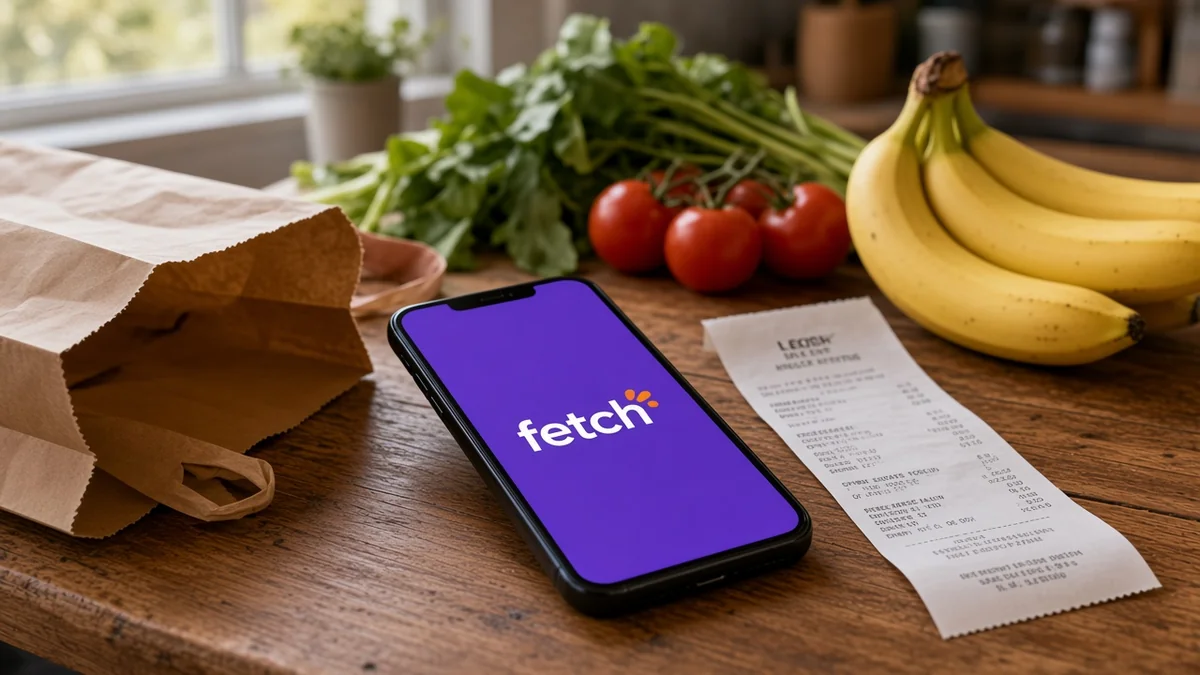
Fetch Rewards makes money by charging brands, retailers, game publishers and online merchants to reach the people who scan receipts in its app. A brand pays Fetch to run an offer or an ad, Fetch passes part of that budget to you as points, and it keeps the rest.
Users pay nothing. On top of that core sit rewarded video ads, Fetch Play game installs, Fetch Shop purchases and a co-branded American Express card.
Fetch (legally Fetch Rewards, LLC, and still “Fetch Rewards” to most users) just wrapped Fetchtopia, a promo running October 21 to 27, 2026 that put more than $15 million in rewards on the table, according to Dallas station CW33. Here’s who funds giveaways like that, what Fetch actually earns, and what you hand over in return.
Key takeaways
- Fetch’s paying customers are advertisers. Brands buy offers and in-app media, and every paid sale is matched to a real receipt.
- Founder Wes Schroll says Fetch is profitable with a $700 million gross revenue run rate and 13 million monthly active users (July 2026).
- That’s roughly $54 a year per monthly user, up from about $40 in late 2024. Growth is coming from earning more per user, not from adding users.
- Using the app means agreeing that Fetch can share your personal information with brand partners. You can opt out.
Who actually pays Fetch?
Fetch is a two-sided business. Shoppers get points. Brands get two things that are hard to buy anywhere else: a nudge at the moment of purchase and proof that the nudge worked.
That proof is the receipt. Fetch says users submit more than 13 million receipts a day, giving it a product-level view of $212 billion in shopper spending (company figures, August 2026). A TV ad can’t tell a cereal brand who bought the box. A Fetch offer can.
It’s a textbook two-sided platform model, and it runs on the same free-to-the-user logic as Pluto TV’s ad-funded streaming. The twist is that Fetch shares part of the ad money with you.
How does Fetch Rewards make money? The 2026 revenue streams
Fetch is private and doesn’t publish a revenue split. The table shows what it has confirmed and what it hasn’t.
| Revenue stream | Who pays | What’s disclosed |
|---|---|---|
| Brand offers and Point Boost | Grocery, household, retail and restaurant brands | Core product on Fetch’s business site; pricing not disclosed |
| In-app display, video and rewarded video | Advertisers | Rewarded video launched Aug 2026, billed per completed view |
| Off-app audiences and retail media | Advertisers on other platforms; Albertsons and Dollar General media networks | Partnerships confirmed; revenue not disclosed |
| Fetch Play | Mobile game publishers | 23 million game installs (reported March 2025) |
| Fetch Shop | Online merchants | 250 merchants, 800,000+ active users (reported March 2025); commission terms not disclosed |
| Fetch American Express Card | Card program partners | Launched fall 2025; Fetch’s share not disclosed |
| Expired points (breakage) | No one directly | Points expire after 90 days of inactivity; no breakage figure reported |
Brand offers and ads: the core business
Most of what you see in the app is paid placement. Fetch’s business site lists Offers (bonus points for buying a specific product), Point Boost, display and video as its main products for brands.
Say a snack brand puts 2,000 bonus points on a family-size bag. The brand pays Fetch for the campaign, the points come out of that budget, and they only land after Fetch spots the product on your receipt.
In August 2026 Fetch added rewarded video: after scanning a receipt, you can opt in to watch a brand’s video for points, and the advertiser pays per completed view rather than per impression. Fetch also lets brands target its purchase-based audiences on other platforms and has tied into retail media networks run by Albertsons and Dollar General.
Fetch Play and Fetch Shop
Fetch Play gives you points for installing and playing mobile games. The game publisher is the customer here. Fetch reported 23 million game installs in its March 2025 update, which makes it a user-acquisition channel for studios.
Fetch Shop rewards online purchases at partner merchants. Fetch hasn’t published its terms, but shopping portals like this usually earn a commission on each referred sale and pass part of it back as points.
The credit card, and the debit card that’s gone
Plenty of articles still list interchange fees from Fetch Pay, its old Mastercard debit card, as a main revenue source. Fetch Pay is no longer offered, so that answer is out of date.
The current card is the Fetch American Express Card, announced in August 2025 and launched that fall. First Electronic Bank issues it and Imprint runs the program. Brands in co-brand card deals typically get a share of card revenue, but Fetch hasn’t disclosed its cut.
How much money does Fetch make?
Fetch doesn’t publish audited accounts, so every number here is self-reported. The trail looks like this:
- 2022: valued at $2.5 billion (reported by CNBC).
- March 2024: said it had turned its first profit.
- Q4 2024: annual revenue run rate of $500 million, up 65% year over year, with 12.5 million monthly active users (Fetch press release, March 11, 2025).
- July 2026: profitable, with a $700 million gross revenue run rate, 13 million monthly active users and about 900 employees, Schroll wrote in Entrepreneur.
Our read: Fetch is earning more from the same people
Divide revenue by monthly users. $500 million across 12.5 million users is $40 per user per year. $700 million across 13 million users is about $54.
Revenue run rate rose 40% while monthly users rose 4%. The growth isn’t coming from sign-ups. It’s coming from new things to sell against the same audience: rewarded video, Play, Shop, off-app targeting and the card.
Two caveats. The 2024 figure is “revenue run rate” and the 2026 one is “gross revenue run rate,” and Fetch hasn’t said whether they’re measured the same way. Run rates also annualize a single strong period, so treat this math as directional.
You’ll also see a claim floating around that 35% of Fetch’s revenue comes from data licensing. I couldn’t find a source for it, and Fetch doesn’t break out data sales.
What does Fetch do with your data?
It shares more than most “Is Fetch safe?” articles admit. Fetch’s privacy policy (last revised October 13, 2026) says that by using the app you consent to it disclosing your information, including personal information, to brand partners that run offers. Those brands can email you and use your data under their own policies.
Fetch also acknowledges this may count as selling or sharing personal data under state privacy laws. It says it doesn’t give brand partners your phone number, precise location or health data. Separately, de-identified and aggregated data can go to third parties for marketing and investment research.
You can opt out of brand-partner sharing through the “Do Not Sell or Share My Personal Information” link on Fetch’s site. If you plan to connect an email inbox for eReceipts, read the full privacy policy first, because that lets Fetch scan the inbox for receipt emails.
How much are Fetch points worth?
About $1 in gift cards per 1,000 points, according to Fetch’s own blog. Most rewards need at least 3,000 points, and your first redemption has to be a $10, $25 or $50 card.
| Fetch points | Approx. gift card value | Note |
|---|---|---|
| 1,000 | $1 | Below the redemption minimum |
| 3,000 | $3 | Minimum for most rewards, after your first redemption |
| 10,000 | $10 | Smallest first redemption |
| 50,000 | $50 | Largest first-redemption tier |
| 200,000 | $200 | Card options vary by retailer |
A few sites say 1,000 points is worth $0.10. That’s ten times lower than Fetch’s own guidance.
What’s the catch with Fetch?
You pay with data and attention instead of cash. In practice that means:
- Your purchase history goes to brand partners unless you opt out.
- Points have no cash value. You redeem them for gift cards, donations, sweepstakes entries or merchandise.
- Points expire after 90 days with no activity, and expired points never get paid out.
- Ordinary receipts earn little. The real points sit in brand offers, which exist to steer what goes in your cart.
If you’d buy those products anyway, it’s a fair trade. If the offers start choosing your groceries, the brands are getting the better deal.
The lesson in Fetch’s model
Lots of apps pay people. Fetch’s edge is selling what brands struggle to get elsewhere: a verified record of what a shopper bought after seeing an offer.
That’s why it charges the brand and not you, much like Afterpay bills merchants for the sales lift it creates. With any “free” app, ask who needs the proof. That’s who’s paying.
FAQ
Is Fetch Rewards legit?
Yes. Fetch Rewards, LLC is a Madison, Wisconsin company founded in 2013, valued at $2.5 billion in 2022, and it partners with American Express on a credit card. It pays out real gift cards. The trade-offs are data sharing, a 90-day inactivity rule and redemption minimums, not a risk of being scammed.
Who owns Fetch Rewards?
Fetch is a privately held company. Wes Schroll founded it with Tyler Kennedy in 2013 and is still CEO. It has raised venture funding, but it doesn’t publish how ownership splits between founders, employees and investors, and it has no publicly traded shares.
How do you make money with Fetch?
You earn gift cards rather than cash. Scan every receipt, focus on brand offers for things you already buy, and use Fetch Play or Fetch Shop for bigger point totals. Redeem or scan at least once every 90 days so your points don’t expire.
Discussion